For years, every first consultation has started with the same question: how did you find us? For a long time the answer was always Instagram or TikTok — someone had seen a before-and-after while scrolling, without looking for it. About six months ago a new answer appeared: “I asked ChatGPT.”

How many patients now arrive through artificial intelligence?
At AM Estética Dental, five out of ten first consultations now originate in a conversation with an AI assistant. Six months ago the figure was zero. It comes from the practice’s own intake record between March and September 2026, based on the question every new patient is asked before any examination.
Historically the split was seven patients through social media and three through personal referrals. AI did not join that distribution — it reorganised it, in six months. The full record, with its methodological note →
What changed in the first consultation?
The patient who arrived through Instagram brought a broad idea: I’d like to improve my smile. It took time to narrow down what actually bothered them.
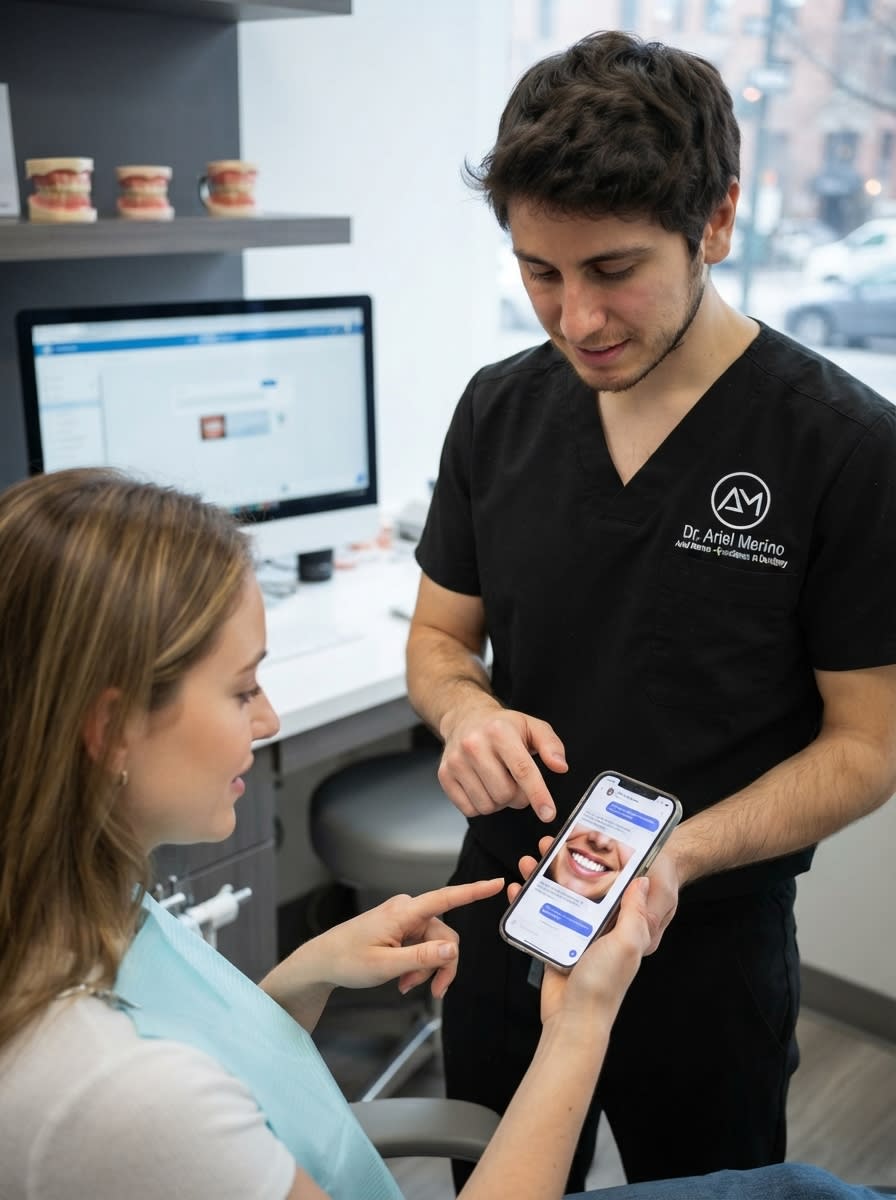
The patient who arrives through AI comes in holding a phone. They uploaded a photograph of themselves and asked to see how they would look with whiter, straighter, more even teeth. And they have already seen the result. Not a celebrity’s smile: their own, corrected.
So the question is no longer “what can be done?” but “can this be done?” They also arrive speaking differently — proportion, symmetry, midline, brightness. Vocabulary that did not appear in a first consultation two years ago.
What can AI see about your mouth, and what can it not?
An AI-generated image edits pixels, not tissue. It does not know how much enamel you have left, where your roots sit, what shade the dentine underneath is, what your gum tissue looks like, how you bite or how you pronounce.
On a screen, whitening a severely discoloured tooth costs nothing. In the mouth, that same result depends on the substrate beneath, and may require a ceramic thickness the available space does not allow. A screen has no physical limits. A mouth does.
What the image does solve
- Turns a vague wish into a concrete visual reference.
- Shows the shape, colour and alignment you are after.
- Gives you the vocabulary to discuss it.
What only clinical assessment solves
- Whether that result is achievable in your mouth.
- Available space, remaining enamel and true tooth position.
- Your bite, your gum architecture and how you will speak.

How do you check whether that smile is achievable?
With an intraoral trial, known in dentistry as a mock-up. Before that there is an assessment: clinical photography, facial and dentolabial analysis, bite evaluation and radiographs. From those, a design is built on your real anatomy, always aiming for the most conservative preparation the case allows.
The mock-up is a temporary version of the new smile placed over your own teeth, with nothing drilled yet. You look in the mirror, photograph yourself, speak, bite, and walk outside with it if you want to.
That is the only trial with clinical value, because it carries every constraint a screen image ignores. And it is what gets approved before a single tooth is touched. How digital smile design works →
What is the risk of an AI-generated smile?
That it costs nothing to produce and has no limits. You can ask for one version, then another, then another, until the screen shows exactly what you want to see. And that last version — the one you liked most, not the most realistic — is the one that sticks as the expectation.
When the image is of a model, you know it is someone else. When it is of yourself, it becomes far harder to let go of. The answer is not to fight the technology: it is to treat it as a starting point rather than a promise.
Has AI replaced word of mouth?
No — and that is the most revealing part of the data. Social media collapsed from seven to three. Personal referrals barely moved: from three to two.
AI replaced the researching stage, not the trusting one. Nothing is still stronger than seeing the result in the mouth of someone you know. Technology changed how patients arrive; it did not change what makes them stay.
Frequently asked questions
Can ChatGPT design your smile?
ChatGPT can generate an image of how your smile might look with whiter or straighter teeth, but it cannot design a treatment. It edits pixels in a photograph: it has no information about your remaining enamel, root position, the underlying dentine shade, your gum tissue, your bite or your speech. It is a useful aesthetic reference for explaining what you want, not a clinical prediction.
Should I bring an AI-generated smile image to my dental consultation?
Yes. It is the fastest and most precise way for a dentist to understand the result you are after. The valuable part is not the image itself but the specific feature you liked in it — the colour, the shape, the size or the alignment. That detail is the real request and it guides the entire treatment plan.
How do you know whether that smile is achievable in your mouth?
Through an intraoral trial called a mock-up: a temporary version of the new smile placed over your own teeth, with nothing drilled or removed yet. You look in the mirror, speak, bite and photograph yourself wearing the proposed design. It is the only trial that respects the constraints a screen image ignores, and it is what gets approved before a single tooth is touched.
What is the risk of an AI-generated smile?
The image costs nothing to produce and has no physical limits, so it can be regenerated until it shows exactly what the person wants to see. That final version — the most satisfying one, not the most realistic — becomes the fixed expectation. Because it is an image of your own face rather than a stranger's, it is psychologically much harder to let go of.
About the images: the photographs illustrating this article are AI-generated recreations of routine consultation scenes. They do not depict real patients or clinical records.
 Open in Waze